
 EN
EN
 CN
CN
As the global digitalization process enters 2026, enterprise expansion into overseas markets is no longer simply about resource export, but a dual game of responsiveness and compliance trust. The "light-speed barrier" caused by vast physical distances—network latency—remains the most critical hard indicator for measuring the quality of cross-border business services.
A single misjudgment of a data center location can mean a sudden increase of over 300 milliseconds in the initial packet response time when reaching target users. This subtle yet fatal latency difference can instantly destroy the user experience. So, how should server rooms be selected in 2026? How should global business nodes be planned? This article will break it down for you from five dimensions.
I. Network Latency: Closer to Users, Higher Conversion Rates
When choosing a data center location, geographical location is the primary consideration. Generally, it is recommended to choose an area close to the target users to reduce network latency and improve access speed. The closer the user and the resource deployment area, the lower the network latency and the faster the access speed.
Studies show that network latency increases by 5-10 milliseconds when data transmission distances exceed 1000 kilometers. For businesses such as financial transaction systems, real-time audio and video, or online games, this can significantly impact the user experience. The core truth of data center selection is always: the closer your computing resources are to the end-user, the higher the conversion rate.
II. Data Compliance: Different Markets, Different Rules
With increasingly stringent data privacy regulations, such as Europe's GDPR and China's Cybersecurity Law, countries are imposing stricter compliance requirements on data storage and processing. When choosing a data center location, businesses must ensure that data storage and processing comply with local laws and regulations.
If your user base is located in EU member states, hosting your business in highly compliant European data centers like those in Frankfurt, Germany, is not only about performance optimization but also about legal risk mitigation. In the face of GDPR regulations, choosing a local European data center compliant with T3+ standards for localized storage is the preferred strategy for cross-border financial and healthcare data businesses.
III. Cost Control: More Than Just Server Rental
The cost of cloud services is an unavoidable factor when choosing a data center. Electricity costs, bandwidth costs, and real estate costs in different regions all affect the overall cost of ownership. Electricity costs constitute a large portion of total operating costs. Choosing a region with low electricity prices and a stable power supply can significantly reduce expenses.
For example, in the Asia-Pacific market, Singapore data center rental prices are among the highest in the region (US$330 to US$475 per kilowatt per month); while US West Coast data centers, benefiting from relatively low industrial electricity prices and a highly mature infrastructure supply chain, offer developers more cost-effective cluster deployment solutions.
Hyperscale data centers prefer regions with low costs and good natural cooling conditions to reduce operating costs, while medium and large-sized data centers choose cities or economic zones close to major markets to reduce data transmission latency. Enterprises need to make trade-offs based on their size.
IV. Practical Guide to Three Core Markets
North American Market: The West Coast is the Performance High Ground
If your core users are concentrated in the US, Mexico, and South America, deploying on the US West Coast is an unshakeable strategic stronghold. The Los Angeles data center boasts the highest density of peering networks in the Northern Hemisphere, consistently providing an average access speed of less than 120 milliseconds across the US.
Asia Pacific Market: Hong Kong – A Lifeline Connecting China and the World
For companies rooted in mainland China with operations radiating across the Asia Pacific region, Hong Kong data centers are the only option that balances the flexibility of "no registration required" with "dedicated line-level" connection quality. Leveraging CN2 GIA enterprise-grade direct connection lines, round-trip latency between Beijing/Shanghai and Hong Kong can be precisely compressed to 30-50 milliseconds.
If your users are primarily in mainland China and Southeast Asia and require low-latency connections back to China, choose Hong Kong; if your users are primarily in Europe, America, and globally and require high bandwidth deployment, choose the United States.
European Market: Frankfurt – The Digital Brain
Frankfurt, as the digital brain of Europe, boasts the DE-CIX core aggregation point. Deploying servers here allows for extremely low-cost access to the entire Western and Northern European continents, with average access latency generally below 40 milliseconds.
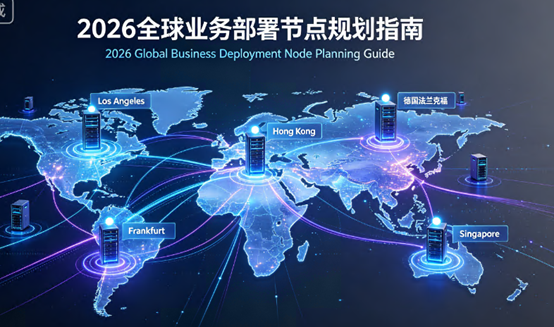
V. Advanced Strategy: From Single Point to Global Matrix
In the multi-cloud era of 2026, a single node will be insufficient to meet the needs of top-tier businesses. We recommend adopting the "audience-centric" approach: use analytics tools to identify core traffic pools, centering on user coordinates, and search for the nearest data center offering service with latency within 100ms.
Data center networks supporting global operations should employ a three-tier architecture: core layer, regional layer, and edge layer. From an investment priority perspective, we recommend building the core layer and regional layers for key markets first, then gradually expanding edge nodes.
In 2026, edge computing is on the rise, with data processing increasingly moving to the network edge. Leading global service providers have deployed hundreds of distributed computing nodes globally, reducing end-to-end latency to millisecond levels. In the next 2-3 years, edge computing will usher in a "golden decade" in more scenarios.
Choosing a server room is never just a technical issue, but a strategic decision. From network latency to data compliance, from cost control to market positioning, every dimension directly impacts the success or failure of the business. In 2026, let every digital asset unleash its maximum value at the most appropriate geographical node. If you are planning your global business node deployment, please contact Jtti; we will tailor a customized global deployment solution for you.