
 EN
 CN
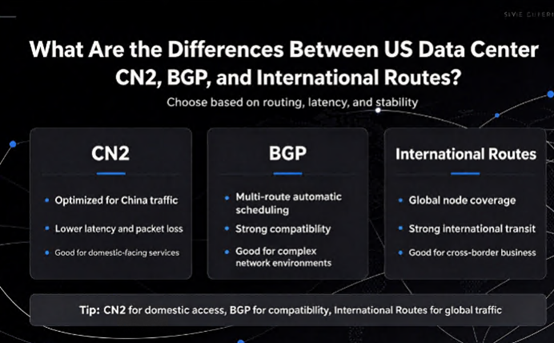
When shopping for US-based servers, you will often encounter terms like "CN2," "BGP," and "International Routes." While they may appear to belong to the same category, they actually address completely different issues.
Choosing the wrong route renders high-end hardware specifications useless; speed tests might look promising during the day, but once evening peak hours hit, page loads stall halfway, and executing a simple SSH command requires a multi-second wait. The problem lies not with the server itself, but with the path data packets take when traveling from the US data center back to China.
Below, we explain the three mainstream routing options for US data centers, covering everything from technical principles to real-world test data.
Standard International Routes: Functional, but with Unpredictable Performance
Standard international routes utilize public BGP backbone networks—essentially a "least-cost" public interconnection path. When data packets travel from the US data center to mainland China, they undergo no China-specific optimization, and routing paths shift constantly.
The defining characteristic of these routes is not necessarily "slow average speed," but rather "unstable performance." Access speeds can vary drastically between users on different ISPs (e.g., China Telecom vs. China Unicom) in the same region; a webpage might load smoothly during the day, yet after 8 PM, latency spikes from 180ms to 300ms, and packet loss jumps from 1% to over 10%.
Real-world data shows that during evening peak hours on standard international BGP routes (e.g., Guangzhou Telecom to Los Angeles), packet loss can reach 12%–28%, with average latency fluctuating between 210ms and 380ms. While this level of performance might suffice for personal blogs or simple informational sites, it is inadequate for tasks like backend administration, API calls, or cross-border form submissions; the retransmissions and timeouts caused by packet loss lead to a precipitous drop in efficiency.
Standard international routes are best suited for scenarios where the user base is primarily overseas, domestic access speed is not a critical requirement, and the budget is limited.
BGP Multi-line: Balancing Connectivity, Not Optimizing "Return-to-China" Quality
BGP is not a specific physical route, but rather a routing management mechanism. Its core value lies in the ability to make more rational traffic distribution decisions based on path status when multiple network paths are available, thereby helping traffic avoid obviously congested routes.
US-based data centers offering BGP multi-homing typically connect to multiple carriers—such as HE, Cogent, and Level3—ensuring broad carrier coverage and excellent global reachability. For businesses with a diverse user base spanning North America, Europe, and Asia, BGP multi-homing provides a relatively balanced access experience.
However, BGP addresses "overall reachability and balance" rather than guaranteeing the lowest latency for any specific fixed route. Crucially, the return path (traffic flowing back to China) for many standard BGP connections still relies on the traditional "163" backbone network. Routing may involve circuitous paths—such as Los Angeles → Japan → Singapore → Hong Kong → Mainland China—resulting in high latency and severe congestion during peak hours. Typical latency for BGP multi-homing ranges from 195ms to 270ms; for businesses primarily serving domestic users, this level of latency remains relatively high.
BGP multi-homing is suitable for scenarios where users are scattered globally and access from multiple regions must be accommodated, or as a transitional solution for those with limited budgets.
CN2 GIA: The Gold Standard for US-China Connectivity
CN2 is China Telecom's next-generation carrier network (Autonomous System number AS4809). CN2 GIA represents the highest tier within the CN2 architecture; both outbound and inbound traffic travel exclusively via dedicated nodes (identified by the 59.43 prefix) and bypass the standard "163" backbone network.
What does this mean? When data packets leave a US data center bound for China, they travel over a dedicated link independent of the public internet. During evening peak hours—when international gateway congestion typically occurs—CN2 GIA traffic benefits from the highest level of QoS (Quality of Service) priority within the China Telecom backbone, ensuring bandwidth is not crowded out by standard traffic.
Real-world test data clearly illustrates the difference. Latency from US West Coast CN2 GIA nodes to coastal cities in mainland China remains stable between 130ms and 160ms, while latency to inland regions ranges from approximately 160ms to 190ms. During evening peak hours, packet loss is typically kept below 1%, and under optimal conditions, it can remain stable at under 0.3%.
For comparison: standard international BGP lines exhibit off-peak latency of 170–210ms and peak-hour latency of 220–320ms, with packet loss ranging from 5% to 18%. CN2 GT, a line with partial optimization, shows off-peak latency of 175–240ms and peak-hour packet loss of 5–15%. In contrast, CN2 GIA keeps peak-hour packet loss below 1.5%.
Latency stability is even more critical. CN2 GIA typically maintains jitter below 20ms, whereas standard international bandwidth can experience jitter spikes of 50–150ms during peak periods. For web page loading and API calls, a stable connection with 150ms latency offers a far better user experience than one that averages 200ms but occasionally spikes to 400ms.
The cost of CN2 GIA directly reflects its quality. The cost per megabit of bandwidth for CN2 GIA is three to eight times that of standard international bandwidth, which explains why US servers utilizing CN2 GIA lines are generally more expensive.
How to verify if a line is "genuine CN2 GIA"
The market contains many "fake CN2 GIA" solutions that optimize only the outbound path (to the destination), while the return path still routes through the 163 backbone network. Verification is straightforward.
Step 1: Perform a traceroute. After obtaining a test IP, run `traceroute` or `mtr` from the server to a domestic China Telecom IP and observe the return path. With genuine CN2 GIA, the return route should consist entirely of nodes starting with `59.43`. If a `202.97` node appears, it indicates that the domestic segment has reverted to the 163 backbone network.
Step 2: Run an MTR test during evening peak hours. Run the command `mtr-rwzc 300 <target_IP>` between 20:00 and 23:00 Beijing Time; for CN2 GIA, the packet loss rate should remain consistently below 0.5%, and latency fluctuations should stay within 20ms. If packet loss rises significantly during evening peak hours, the line quality fails to live up to its claims.
Step 3: Check if the provider offers a test IP. Reputable providers usually supply a test IP so users can verify the return route themselves. The test IP for Jtti’s US node is 177.3.40.254; you can run traceroutes at different times to confirm whether the return path travels entirely through the 59.43 CN2 GIA nodes.
Jtti US CN2 Plans: Real-world Data and Pricing
Now that we understand the differences between the three types of lines, let’s look at the actual configuration of Jtti’s US node.
Jtti’s Los Angeles data center utilizes premium bidirectional CN2 GIA lines, with the return path routed entirely through dedicated 59.43 nodes. Real-world data shows that average latency across the three major Chinese carriers remains stable between 130ms and 160ms—with measured latency of 133.93ms from Suzhou and 128.28ms from Taipei—while the packet loss rate within China holds steady at around 0.2%.
All Jtti plans feature a lifetime recurring discount policy; the initial purchase price is identical to the renewal price, avoiding the common "low price for the first year, double the price the next" tactic. Amid rising hardware costs projected for 2026, this policy ensures that long-term operating costs remain fully predictable.
The three types of US data center lines essentially represent three distinct products. International lines offer "broad coverage and low cost," BGP multi-line connections offer "balanced scheduling across multiple carriers," and CN2 GIA offers "low latency and high stability for traffic directed toward mainland China." If your user base is primarily in mainland China and your operations team is also domestic, CN2 GIA is the option most worthy of serious consideration.