
 EN
EN
 CN
CN
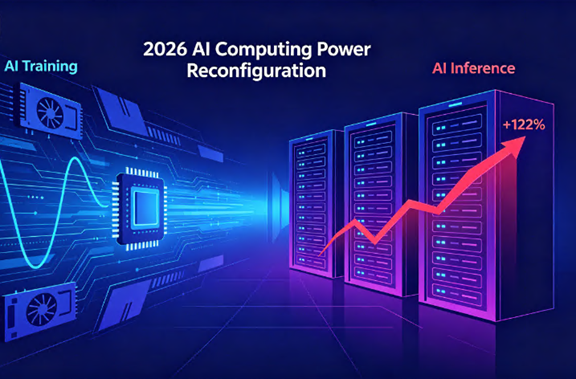
In 2026, the global AI industry is undergoing a profound structural transformation. According to TrendForce data, AI training computing power among the top five North American cloud service providers is expected to grow by 56% in 2026, while inference computing power will surge by 122% — more than double the growth rate of training. IDC further predicts that by 2029, inference computing will account for nearly 80% of China's market. This means the main battlefield of computing power is shifting from centralized training to large-scale inference applications — the AI industry is moving from "training models" to "running applications."
At the same time, the large-scale deployment of AI Agents is accelerating this trend. 2026 is widely regarded as the "first year of AI Agent implementation". Multiple cloud vendors have centrally released Agent infrastructure solutions in the first half of the year, signaling that Agent infrastructure is moving from the proof-of-concept phase to large-scale delivery. However, Gartner predicts that by the end of 2027, over 40% of AI Agent projects will be canceled. Why? An AWS global VP pointed out that the difficulty of introducing Agents into real business scenarios lies not in the models themselves, but in building tool connections, permission controls, observability, and governance audit systems to stably, securely, and governably integrate model capabilities into actual business systems.
How Does the Shift in Computing Demand Structure Affect Ordinary Users?
For individual website owners, SMEs, and developers, the surge in inference computing demand brings a direct change: AI capabilities are moving from "exclusive to big players" to "accessible to everyone," but the cost of accessing available computing power continues to rise.
Over the past two years, Token prices experienced a "cliff-like" decline, dropping from an initial price of 50-100 yuan per million Tokens to just a few yuan or even a few cents. But price affordability ultimately could not keep pace with the exponential expansion of call volumes. National Data Bureau data shows that China's daily average Token calls surpassed 140 trillion in March 2026, up from just 100 billion in early 2024 — a more than 1,000-fold increase in two years. As the supply-demand balance shifts, a correction in computing prices became inevitable. In March 2026, domestic and international cloud vendors successively issued price adjustment announcements within 10 days, with core AI computing and storage service prices generally rising by 30% to 50%, and some core products seeing increases as high as 400%.
Meanwhile, the industry's competitive logic is undergoing a fundamental shift. Professor Ruan Jing from Capital University of Economics and Business pointed out that in the AI era, what determines competitive success is no longer just low-cost supply of general-purpose computing, but who can consistently provide stable, sufficient, and schedulable high-end computing power. Li Wei, Deputy Director of the Cloud Computing and Digitalization Research Institute at the China Academy of Information and Communications Technology, also noted that intelligent computing has shifted from the early construction phase to the large-scale service phase, with cloud computing becoming the optimal choice for users' AI computing services. For ordinary users, this means the criteria for server selection need to shift from "who is cheaper" to "who is more stable and more predictable in the long run."
Facing the Computing Power Shift, How to Make the Right Server Selection Decision?
In 2026, as computing power becomes increasingly expensive and inference demand continues to surge, the following three selection principles are worth serious consideration:
Principle 1: Calculate long-term costs and beware of the "low first-year price, doubled renewal" trap. Most cloud servers offer extremely low initial prices but double or even triple upon renewal. By the time your website is running and data migration is complete, you discover that renewal costs far exceed your budget, leaving you trapped in a "can afford to use, can't afford to renew, can't move out" predicament. JTTI's "lifetime recurring discount" policy ensures that the purchase price and subsequent renewal prices remain consistent, making long-term costs transparent and predictable without the need for frequent migrations due to renewal price hikes.
Principle 2: Prioritize network quality — don't just focus on configuration parameters. AI inference applications are extremely sensitive to response latency — the response speed of an AI chatbot directly determines user retention. JTTI Hong Kong CN2 cloud servers feature China Telecom CN2 GIA direct routing, China Unicom CUG optimization, and China Mobile CMI direct routing, with round-trip latency below 30ms for all three major domestic carriers. Japanese lightweight cloud servers leverage premium lines such as SoftBank, IIJ, and KDDI, delivering average latency below 50ms across Asia, making them particularly suitable for TikTok operations, cross-border e-commerce, and game acceleration.
Principle 3: Multi-node coverage for nearest deployment. As businesses expand, a single node often cannot meet the access needs of global users. JTTI covers multiple popular data centers including Hong Kong, Japan, the United States, and Singapore, allowing users to choose the nearest node based on their target market, effectively reducing access latency and improving the user experience of AI applications.
The explosive growth of AI inference computing demand is reshaping the resource allocation landscape of the entire cloud computing industry. TrendForce predicts that AI server shipments will grow by over 28% year-over-year in 2026, and the significant growth in inference computing demand reflects the industry's shift from "training models" to "running applications." For everyone who depends on cloud services, this is both a challenge and an opportunity to re-evaluate server selection strategies. In this era of increasingly expensive computing and surging inference demand, choosing the right configuration, the right network, and the right long-term cost plan matters more than ever.