
 EN
 CN
When purchasing and using a VPS, "overselling" and "reselling" are two frequently encountered concepts that are often misunderstood. One concerns whether your server's performance is "inflated" (i.e., resources are promised but not physically available), while the other concerns whether the service you purchased has passed through multiple layers of intermediaries. Understanding the mechanics behind these practices is crucial for selecting a reliable service provider.
What is VPS overselling?
The logic behind overselling is simple: the total amount of resources sold by the provider exceeds the actual resources available on the physical server. For instance, a physical machine might have 64GB of RAM, yet the provider sells VPS packages totaling 100GB of RAM, betting on the fact that most users will not fully utilize all their allocated resources simultaneously.
For providers, overselling is a key strategy for boosting profits. It significantly improves hardware efficiency, reduces the rate of idle resources ("wasted capacity"), and lowers hardware investment costs. Industry data indicates that the average overselling rate in the virtual hosting market ranges from 150% to 300%, with some low-cost providers exceeding 500%.
However, the impact of overselling on users is systemic. While the experience remains acceptable with mild overselling (within 1.5 times capacity), severe overselling (over 3 times capacity) inevitably leads to a drastic drop in performance. CPU overselling causes "steal time" to spike, resulting in noticeable lag when typing SSH commands during peak hours; RAM overselling forces the system to use swap memory, causing read/write speeds to plummet from the nanosecond range to the millisecond range; disk I/O overselling makes database queries and file operations extremely slow; and bandwidth overselling leads to congestion at the shared network egress point during peak times, causing sharp increases in network latency and packet loss.
What is VPS reselling?
Reselling involves individuals or enterprises purchasing VPS resources in bulk from an upstream provider and then repackaging or splitting them to sell to end customers under their own brand. In short, the "service provider" you are dealing with might simply be a "middleman" who buys resources wholesale from a large data center and sells them at retail.
The reselling model has a very low barrier to entry for businesses—they can operate under their own brand without needing to build data centers or maintain hardware. For end users, the benefits include potentially more flexible product combinations and localized customer support.
However, the risks associated with reselling are equally significant. Service quality relies heavily on the upstream provider; if the upstream provider experiences outages or changes strategies, both the reseller and their customers are directly affected. Furthermore, the more layers of resale involved, the greater the likelihood of price markups at each stage, and technical support may become sluggish due to the reseller's lack of control over the underlying infrastructure. A more hidden risk is the potential instability of the reseller's own business operations; should they cease operations, customers face the risk of being left without support for their data and services.
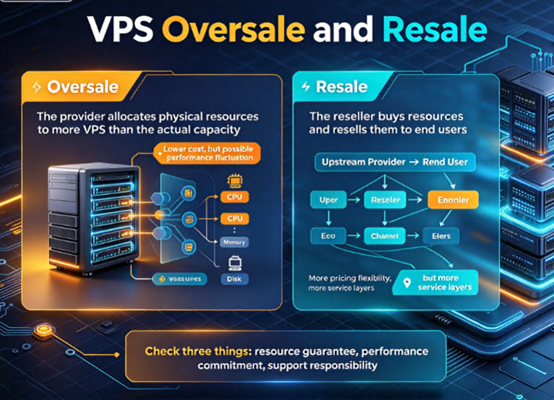
Fundamental Differences Between Overselling and Reselling
While easily confused, the two concepts are fundamentally different.
Overselling is a form of "over-commitment" at the resource level; it occurs at the physical server layer and directly impacts performance. A VPS that is not oversold offers stable, predictable performance, whereas a heavily oversold VPS experiences drastic performance fluctuations driven by the activities of "neighboring" instances on the same host.
Reselling is a form of "channel distribution" at the sales level; it operates within the realm of business relationships. A resold VPS may not necessarily suffer from poor performance, but its stability and service quality depend on the strength of the partnership between the reseller and the upstream provider, as well as the adequacy of technical support.
In short: Overselling affects "speed," while reselling affects "accountability and service stability."
How to Evaluate and Choose?
You can determine if a service is oversold by checking a few technical indicators: if the `%st` (Steal Time) in the `top` command consistently exceeds 5%–10%, it indicates severe CPU contention; if `free -h` shows consistently high Swap usage, it suggests insufficient memory; and if `iperf3` bandwidth tests during peak evening hours reveal speeds far below the advertised rates, it indicates the bandwidth is being heavily shared.
When evaluating reselling services, transparency and control over the underlying infrastructure are key. Credibility is significantly higher if the provider clearly outlines the network architecture of their underlying data centers, confirms ownership of ASN and IP resources, and demonstrates that their technical support team possesses low-level infrastructure maintenance capabilities. Conversely, vague responses regarding these issues should raise a red flag.
Jtti positions itself as an infrastructure service provider rather than a reseller. Jtti operates its own Tier 3+ (T3+) data centers in Hong Kong, the US, Japan, and Singapore, maintaining full control over everything from server racks and bandwidth to server hardware. This means users receive services without passing through any intermediary layers, and technical issues can be addressed directly by the infrastructure engineering team. Regarding resource allocation, Jtti’s entire product line comes standard with dedicated bandwidth and independent IP addresses, eliminating issues such as "bandwidth contention from neighbors" or "guilt-by-association" risks associated with shared IPs. For users prioritizing performance stability and long-term control, opting for a provider that owns its underlying infrastructure offers far greater peace of mind than navigating the complexities of multi-layered reseller channels.
Understanding concepts like overselling and reselling enables you to make more informed purchasing decisions. While overselling is not inherently a "cardinal sin," uncontrolled overselling inevitably degrades the user experience; similarly, reselling is not necessarily a "scam," yet a lack of transparency can create long-term hidden risks. Visit the Jtti official website to learn about their proprietary infrastructure and transparent resource policies, and choose a provider with a solid foundation.