
 EN
 CN
When choosing a VPS, many people face a common dilemma: one plan offers 10 Mbps bandwidth with unlimited data transfer, while another offers 100 Mbps bandwidth with a 1 TB monthly data cap. With similar prices, which one offers better value?
The answer isn't about which is "more important," but rather about what your specific business is most vulnerable to. Bandwidth determines the speed ceiling, while data transfer determines the usage quota. One governs "how fast you run," and the other governs "how far you go." Both are essential, but their relative importance varies significantly depending on the scenario.
First, let's clarify the concepts: what exactly do bandwidth and data transfer mean?
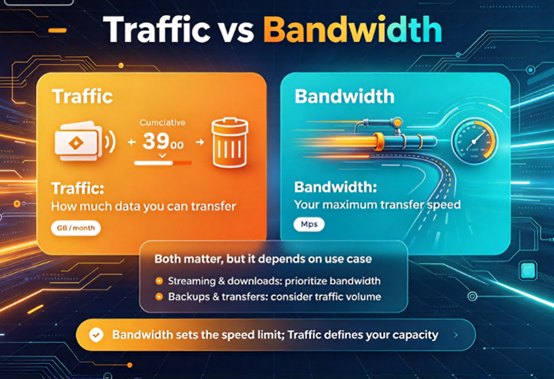
Bandwidth is measured in Mbps (Megabits per second) and represents the maximum amount of data that can be transmitted through the network channel per second. Think of it like the diameter of a water pipe: the wider the pipe, the more water can flow through it in a given amount of time.
Data transfer is measured in GB or TB and represents the total amount of data that can be transmitted within a billing cycle. Think of it like a water meter reading: once the quota is exhausted, you either face speed throttling or have to pay extra fees.
There is a simple conversion relationship between the two. Take 10 Mbps dedicated bandwidth as an example: if utilized at full capacity continuously, it would consume approximately 3.2 TB of data in a month. Conversely, with 100 Mbps bandwidth, a 1 TB data allowance would be exhausted in less than 24 hours if transmitted at full speed continuously. This conversion highlights a key point: higher bandwidth leads to faster data consumption, while a larger data allowance supports longer periods of high-bandwidth usage.
Bandwidth-sensitive scenarios: speed defines the experience
Some business applications prioritize bandwidth far more than total data volume. They share a common characteristic: while the data volume of a single request or transfer is small, the applications are extremely sensitive to latency and jitter, requiring a network channel that is both wide and stable.
Traffic forwarding for AI tools is a prime example of a bandwidth-sensitive scenario in 2026. Developers using local tools like Hermes Agent or Claude Code need to forward API requests through overseas nodes. Although each request involves only a few kilobytes to tens of kilobytes of data, the frequency of requests is high, and response time is critical. Insufficient bandwidth causes requests to queue, while significant line jitter leads to stuttering in streaming outputs. These scenarios require dedicated bandwidth and optimized network routes rather than massive data transfer allowances.
The same applies to video conferencing, remote desktop applications, and game acceleration. They may not consume a vast amount of data, but insufficient bandwidth results in lag, packet loss, and input latency. The experience of using a dedicated 5Mbps CN2 GIA connection is often far superior to that of a standard 100Mbps shared international connection.
E-commerce backend management and cross-border operations fall into this category. Tasks such as multi-platform order processing, inventory synchronization, and customer service messaging involve small amounts of data per action but require frequent operations. Stable bandwidth and low latency are essential to ensure the backend runs smoothly without lag.
For such scenarios, Jtti’s Hong Kong Lightweight Cloud plan—featuring 200Mbps dedicated bandwidth—is a compelling option. The 200Mbps bandwidth ensures stable handling of large-scale concurrent requests, while the dedicated nature of the connection prevents contention with other users during peak periods. With monthly pricing starting as low as $10.39, it is well-suited for lightweight business operations with specific bandwidth requirements.
Traffic-sensitive scenarios: Data volume equals cost
Another category of business operations does not require high bandwidth but consumes massive amounts of data traffic. These operations share common characteristics: they involve large data transfers per session or generate continuous data transmission over long periods.
Data backup and file synchronization are classic examples of traffic-sensitive scenarios. Regularly syncing server data to off-site storage involves significant volume; a single full backup might reach tens of gigabytes, while incremental backups can amount to several gigabytes. Over the course of a month, total traffic consumption can easily exceed 1TB. With usage-based billing, costs rise linearly with data volume; however, with an unlimited traffic plan, costs remain fully predictable and controlled.
Web scraping and CDN origin fetching follow a similar pattern. Web scrapers continuously harvest external data, and CDNs frequently fetch content from the origin server; while these operations may only require a few Mbps of bandwidth, the cumulative traffic consumption is substantial. Consequently, a low-bandwidth plan with unlimited traffic is more cost-effective than a high-bandwidth plan with strict traffic limits.
Download sites and mirror sites represent extreme cases of traffic consumption. User downloads generate continuous outbound traffic; while high bandwidth isn't necessarily required, a large traffic allowance is essential. These scenarios demand plans that offer either unlimited traffic or substantial data quotas.
For these scenarios, Jtti’s US-based CN2 plan—featuring 1 vCPU, 1GB RAM, 5Mbps CN2 bandwidth, and unlimited traffic (priced at $36.93/year)—offers an alternative approach. Although the 5Mbps bandwidth is modest, the CN2 GIA connection ensures high-quality return-path performance, and the unlimited traffic policy eliminates concerns about speed throttling due to overage. The Hong Kong CN2 plan featuring 1 vCPU, 1GB RAM, 2Mbps CN2 bandwidth, and unlimited data (priced at $49.86/year) is also well-suited for workloads that involve high data transfer volumes but do not require high bandwidth speeds.
Balanced Scenarios: Connection Quality Matters More Than Raw Numbers
Most corporate websites, independent e-commerce sites, and API services fall somewhere in the middle regarding bandwidth and data transfer needs. They typically require 5Mbps to 10Mbps of dedicated bandwidth to ensure fast page loading, with monthly data usage ranging from a few hundred gigabytes to several terabytes—levels that are not considered extreme.
In these scenarios, the most critical factor is not the raw bandwidth or data figures, but the quality of the network connection. A 5Mbps CN2 GIA connection offers far greater stability during evening peak hours than a 100Mbps shared standard connection. The former maintains a packet loss rate below 0.5%, whereas the latter can see rates spike above 5%. For operations where a single lost packet can cause a failure—such as e-commerce payment processing or API callbacks—connection quality directly determines service availability.
Jtti’s Hong Kong CN2 plan—featuring 2 vCPUs, 4GB RAM, 5Mbps CN2 bandwidth, and unlimited data ($29.36/month)—strikes an optimal balance across bandwidth, data transfer, and connection quality. The 5Mbps dedicated CN2 bandwidth ensures fast page loading, the unlimited data allowance eliminates concerns about overage charges, and the CN2 GIA direct connection across major carriers guarantees stability during peak evening hours.
Avoiding Three Pitfalls Behind "Unlimited Data" Offers
Users with high data transfer needs are often drawn to "unlimited data" offers, yet this label frequently conceals hidden restrictions.
The first pitfall is the Fair Usage Policy (FUP). Many unlimited data plans include FUP clauses that may throttle speeds if sustained, maximum-speed data transfer occurs over a long period. While normal business operations rarely trigger these limits, users running download sites or high-volume data forwarding services should verify the specific thresholds in advance.
The second pitfall is shared bandwidth. Although the advertised bandwidth figure may be high, multiple VPS instances on the same physical server share the same outbound connection. If a "neighbor" on the same server maxes out their usage during peak hours, your available bandwidth can be squeezed down to a mere fraction of the advertised speed. The performance gap between dedicated and shared bandwidth becomes significantly more pronounced during peak periods.
The third pitfall is the confusion between peak bandwidth and guaranteed bandwidth. "100Mbps peak bandwidth" sounds impressive, but "peak" merely indicates the speed achievable in a momentary burst; it does not guarantee sustained performance at that level. "Guaranteed bandwidth," on the other hand, represents the stable speed you can rely on at any time.
Selection Logic: Calculate First, Choose the Line Second
Let’s revisit the initial question: Is data transfer volume more important, or is bandwidth?
First, calculate your peak bandwidth requirements. How much concurrent throughput does your business need during peak periods? Consider the bandwidth required for page loads, API responses, and file transfers, and use this figure as your baseline.
Next, calculate your monthly data consumption. Multiply your average daily usage by 30 days and add a buffer for traffic spikes. If your monthly consumption exceeds 500GB, you should seriously consider an unmetered (unlimited) data plan.
Finally, evaluate line quality. While bandwidth and data volume are just numbers, line quality defines the actual user experience. The stability provided by a CN2 GIA line is often more valuable than an extra 10Mbps of bandwidth.
Jtti operates across four major nodes—Hong Kong, the US, Japan, and Singapore—with dedicated bandwidth and CN2 GIA/optimized lines as standard features across its entire product range. We offer bandwidth options from 2Mbps to 200Mbps, as well as unmetered data plans. Our lifetime recurring discount policy ensures that the renewal price matches the initial purchase price, allowing for predictable long-term operating costs—even amidst rising hardware costs projected for 2026.
The choice between bandwidth and data volume isn't an "either-or" dilemma; it is a matter of prioritizing based on your specific business scenario. For bandwidth-sensitive businesses, prioritize speed; for data-sensitive businesses, prioritize capacity; and for balanced workloads, prioritize line quality.