
 EN
EN
 CN
CN
Some call IPLC “the premium choice for cross‑border networks,” while others consider it “an outrageously expensive leased line.” So what exactly is IPLC? How does it differ from CN2 GIA, IEPL, and other routes? And what kind of business truly needs it?
IPLC, short for International Private Leased Circuit, is a point‑to‑point dedicated international communication line. In simple terms, it is a private cross‑border link where the user enjoys exclusive use of the entire bandwidth, and data never passes through the public Internet.
To use an analogy: a regular public Internet route is like a crowded city artery – everyone uses it, and during peak hours it is jam‑packed. CN2 GIA is similar to a “bus lane” – faster than ordinary lanes, but still potentially affected during rush hour. IPLC, on the other hand, is a private underground tunnel – built solely for you, with no other vehicles, no traffic lights, and direct access to your destination.
IPLC uses carrier‑grade transmission technologies such as SDH/WDM, operating at the physical or data link layer, and is completely transparent to upper‑layer communication protocols. This means it can carry any type of business data – voice, video, ERP systems, database synchronization – all can run over it. Typical applications include Shenzhen‑Hong Kong IPLC (point‑to‑point transmission from Shenzhen to Hong Kong) and Shanghai‑Japan IPLC (direct connection from Shanghai to Japan), with domestic latency generally controllable within about 40ms.
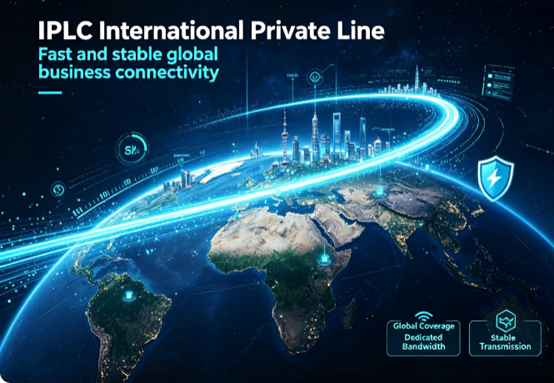
The Five Core Advantages of IPLC
- Ultra‑low latency, direct without detours. IPLC connections generally go directly from domestic points to Hong Kong, the US, Singapore, and other nodes, without detouring through Southeast Asia, Europe, or multiple intermediate hops. Fewer hops and faster direct routing – measured Shanghai‑Japan IPLC latency can be as low as 26ms.
- Near‑zero packet loss, rock‑solid stability. Since data does not pass through public Internet nodes, IPLC packet loss is extremely low, generally staying below 0.1% over long periods. Compared with BGP routes that often suffer from packet loss and multiple hops, IPLC offers near‑0% packet loss, making it especially suitable for business systems with extremely high connectivity requirements.
- Physical isolation, exceptionally high security. IPLC uses physical‑layer isolation technology with fully dedicated bandwidth, free from interference by other users. Data is transmitted within a dedicated channel, not over the public Internet, greatly reducing the risk of eavesdropping or attacks. For enterprises transmitting confidential information, financial statements, or sensitive databases, this level of security is unmatched by ordinary public networks.
- Immune to network fluctuations. IPLC runs on an internal‑network channel and is unaffected by international link fluctuations or network congestion. The latency fluctuations and packet loss spikes that commonly occur on public routes during peak evening hours are completely absent on IPLC.
- Protocol transparency and strong carrying capacity. IPLC is fully transparent to upper‑layer protocols and supports the transmission of integrated information including voice, data, images, fax, and video. It offers a wide range of selectable transmission rates, from N×64K to 2Mbps, 45M, 155M, and even higher.
The “Drawback” of IPLC: Expensive – and I mean it
The biggest drawback of IPLC is its cost. As a physical leased line, IPLC involves high initial deployment expenses, a long provisioning cycle, and limited flexibility in bandwidth adjustment. A 100M leased line from Hong Kong to mainland China can cost over $10,000 per month. IPLC‑based VPS prices are typically 1.5 to 3 times or more than those of CN2 VPS.
But there is a reason for the high price – for businesses like financial trading and real‑time data synchronization where “latency is money,” the stability and security that IPLC delivers are well worth the cost.
What Other Lines Are Comparable to IPLC?
- IEPL (International Ethernet Private Line). IEPL can be thought of as “an Ethernet upgrade of IPLC.” The core difference lies in the technical architecture: IPLC uses traditional SDH/PDH technology based on time‑division multiplexing, while IEPL is based on Ethernet technology using packet encapsulation. In simple terms, IPLC emphasizes stability and real‑time performance, whereas IEPL emphasizes compatibility and convenience. IEPL offers flexible bandwidth adjustment (minimum unit 2M), shorter deployment cycles, and supports point‑to‑multipoint networking. For the same bandwidth, IEPL generally has lower deployment costs. For core business that is extremely sensitive to latency and jitter (e.g., financial trading) → choose IPLC; for those prioritizing networking convenience, compatibility, and cost control → choose IEPL.
- MPLS (Multi‑Protocol Label Switching Virtual Private Network). MPLS is a Layer‑3 technology based on the carrier’s private network. It achieves high‑speed packet forwarding through label switching, with high reliability and QoS guarantees. Compared with IPLC, MPLS has the advantage of supporting multi‑site networking (headquarters + multiple branch offices) with greater flexibility; its disadvantage is that it still falls into the category of “virtual” leased lines, and its security and bandwidth exclusivity are not as strong as IPLC’s physical isolation. It is suitable for enterprises with many branch offices requiring multi‑point interconnection.
- CN2 GIA (China Telecom Global Internet Access). CN2 GIA is the highest‑grade product on China Telecom’s CN2 backbone network, with all traffic passing through CN2‑dedicated nodes beginning with 59.43. Compared with the traditional 163 backbone network, CN2 GIA offers lower latency, less packet loss, and higher stability. However, there is an essential difference between it and IPLC: CN2 GIA is an “optimised public network,” while IPLC is a “physically isolated private network.” CN2 GIA still travels over the public Internet and may be affected by international egress congestion during peak hours; IPLC, in contrast, does not use the public network at all and is free from any external interference. For those on a limited budget whose main need is to improve the quality of domestic access to overseas resources → CN2 GIA offers excellent cost‑performance; for businesses with extreme stability and security requirements → IPLC is irreplaceable.
Which Scenarios Is IPLC Suitable For?
Scenario 1: Cross‑border financial trading and high‑frequency trading. The financial industry demands latency at the millisecond level. The ultra‑low latency and near‑zero packet loss provided by IPLC ensure that trading instructions reach their destination in the shortest possible time. Cross‑border fund settlements, stock market data feeds, high‑frequency trading systems – in these scenarios, an extra 10 milliseconds of latency can mean millions in losses.
Scenario 2: Core system interconnection for multinational enterprises. The ERP systems, OA systems, and mail servers of multinational enterprises need to synchronise data in real time among branches in different countries. The stability and security of IPLC guarantee 7×24 smooth operation of core business systems.
Scenario 3: Real‑time video conferencing and voice communications. Video conferencing is extremely sensitive to network jitter and packet loss. IPLC provides fixed latency and extremely low jitter, ensuring that cross‑border video conferences are free from lag and disconnections.
Scenario 4: Game acceleration and premium game servers. Many domestic streamers and high‑end game servers choose IPLC routes. Measured Shanghai‑Japan IPLC latency of 26ms is a completely different experience compared with the 50–60ms or even over 100ms often seen on public networks.
Scenario 5: Cross‑border big data synchronisation and disaster recovery. When enterprises need to back up domestic data in real time to overseas servers, IPLC ensures transmission stability and security, preventing packet loss or transmission anomalies.
Scenario 6: Foreign‑trade e‑commerce and cross‑border collaboration. The foreign‑trade industry has extremely high demands for cross‑border communication quality. Deploying services or using IPLC VPS via Hong Kong or Singapore as a jump server can greatly reduce latency and lag, improving back‑end operations and order synchronisation efficiency.
Jtti’s IPLC Leased Line Services
As a global network infrastructure service provider registered in Singapore, Jtti has deep technical expertise and extensive route resources in the IPLC field. Its IPLC leased lines cover popular cross‑border routes such as Shenzhen‑Hong Kong, Shanghai‑Japan, and China‑US, offering a range of bandwidth plans from entry‑level to enterprise‑grade.
Jtti’s IPLC‑based VPS offers the following core advantages:
- Physical‑layer isolation: data never passes through the public Internet, with packet loss consistently below 0.1%
- Ultra‑low latency: popular routes such as Shenzhen‑Hong Kong and Shanghai‑Japan can achieve latency within 40ms
- Dedicated bandwidth: users lease bandwidth on demand and enjoy exclusive use, free from interference by other users
- Protocol transparency: supports transparent transmission of voice, data, video, and other services
- 7×24 technical support: enterprise‑grade SLA guarantees business continuity
Whether it is cross‑border financial trading, multinational corporate intranet interconnection, high‑end game servers, or foreign‑trade e‑commerce platforms, Jtti provides customised IPLC leased line solutions.
| Line Type | Core Features | Suitable Scenarios | Cost |
| IPLC | Physical isolation, ultra‑low latency, near‑zero packet loss | Financial trading, core systems of multinational enterprises, real‑time video | Highest |
| IEPL | Ethernet architecture, flexible adjustment, quick deployment | SME cross‑border networking, multi‑point interconnection | Medium‑high |
| MPLS | Multi‑site networking, QoS guarantee | Multinational enterprises with many branch offices | Medium |
| CN2 GIA | Optimised public network, high cost‑effectiveness | Cross‑border e‑commerce, foreign‑trade websites, remote office | Medium |
In a nutshell: IPLC is the “premium choice” for cross‑border networks – expensive, but rock‑solid. If your business has extreme requirements for latency, packet loss, and security, IPLC is the only way to go. If your budget is limited, CN2 GIA is a highly cost‑effective alternative. And Jtti’s IPLC leased line services are precisely tailored for those businesses that simply “cannot afford to fail.”