
 EN
EN
 CN
CN
As stated, this is a core concern for many website owners and businesses. The answer is: the presence or absence of an SSL certificate has a direct impact on GEO, but the "level" of the SSL certificate (DV, OV, EV) does not make a direct difference to GEO.
In GEO's trust system, HTTPS/SSL belongs to the "underlying infrastructure." "Trust" in GEO is built on two layers: the content layer (product facts, capabilities, case evidence) and the infrastructure layer (whether the site can be accessed stably and whether data transmission is protected). If the infrastructure layer is unstable or insecure, the credibility of the content becomes difficult to verify and adopt.
Specifically, the impact of HTTPS on GEO is reflected in three aspects:
- Crawling stability: AI-related discovery typically begins with web page access and retrieval. HTTPS reduces browser/crawler security warnings, prevents mixed content from being blocked, and avoids content crawling failures due to incomplete rendering.
- User security: After users obtain information through AI, they may visit the original website for deeper understanding. HTTPS protects form submissions and session data from being exposed during transmission.
- Verifiable trust signals: SSL/TLS certificates provide verifiable identity binding (domain ↔ certificate), which is a foundational condition for a website to be considered a legitimate, safely accessible source of knowledge. When building the knowledge graph of information sources, GEO engines identify protocol consistency—mixing HTTP and HTTPS resources can cause pages to be marked as "partially encrypted," reducing the overall trust score weight and affecting the reference priority of that site in AI-generated results.
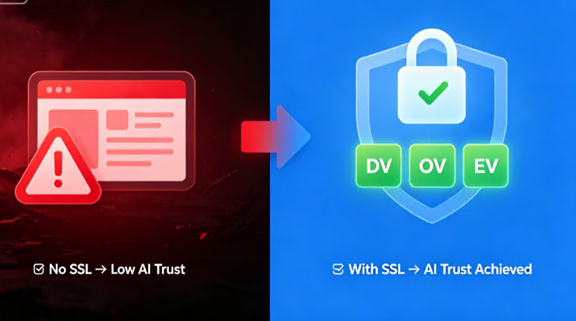
If a website has not deployed HTTPS, its content is at risk of being tampered with during transmission. When AI models encounter information from HTTP websites in their training data, the algorithm may automatically lower the weight of that information. This means that even with high-quality content and proper keyword optimization, websites without an SSL certificate will be at a disadvantage in AI reference priority.
SSL certificate levels, ranked from lowest to highest by verification rigor, fall into three types: DV (Domain Validation), OV (Organization Validation), and EV (Extended Validation) . There is no difference in encryption strength among the three—all support TLS 1.2/1.3 protocols and SHA-256 algorithms. The differences primarily lie in identity verification depth and trust display.
DV certificates validate only domain ownership, making them suitable for personal blogs and small to medium-sized websites. OV certificates verify business entity identity, making them ideal for corporate websites. EV certificates undergo the most rigorous business scrutiny and display the company name in the browser's address bar.
However, from the perspective of GEO, AI models are concerned with "whether this website provides a secure, verifiable data transmission channel through HTTPS," not "whether this website's SSL certificate is DV or EV." As long as a valid SSL certificate is deployed and full-site HTTPS is implemented, the AI has met the infrastructure layer requirements in its trust assessment. The green address bar and company name display brought by EV certificates impact human users' sense of trust and conversion rates more than they affect AI's citation decisions.
When formulating their GEO strategy, businesses should prioritize completing full-site HTTPS deployment, regularly checking certificate validity, and ensuring the security and reliability of data transmission links. Specifically, the following points should be noted:
- Enforce site-wide 301 redirects to HTTPS, ensuring all HTTP traffic is redirected to the HTTPS version
- Eliminate mixed content, avoiding the mixing of HTTP and HTTPS resources—GEO engines will identify protocol inconsistencies and lower trust scores
- Confirm the certificate chain is complete, ensuring the TLS protocol version is TLSv1.2 or higher
- Configure HSTS (HTTP Strict Transport Security) policy to force browsers to always access the site via HTTPS
GEO is the new battlefield for brands to gain visibility in the AI search era. The core factors influencing GEO include content structure, factual density, authoritative sources, information consistency, and technical accessibility. SSL certificate deployment is the foundational threshold for GEO's trust system—having a certificate is a prerequisite, but the certificate level (DV/OV/EV) does not directly affect AI's citation decisions.
For businesses and website owners looking to improve their GEO performance, it is recommended to prioritize the following: Deploy an SSL certificate for full-site HTTPS → Optimize content structure and factual density → Establish authoritative source endorsements → Maintain cross-platform information consistency. On this basis, choose the appropriate SSL certificate level based on business needs—DV certificates are sufficient for basic GEO trust requirements for ordinary websites; for scenarios that demand the highest level of user trust, such as finance or government services, OV or EV certificates may be considered.