 EN
EN
 CN
CN
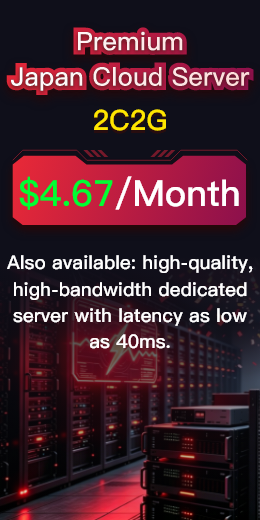
For businesses targeting the Asia-Pacific market, especially those sensitive to network quality, the value of a VPS lies in the balance between its line quality, resource allocation, and long-term cost. Jtti's recently launched 2C2G special offer package in its Tokyo, Japan data center, priced at approximately $4.67 per month, has sparked considerable discussion. So, is this machine a "super high-performance machine" or a "low-price trap"? We'll break it down from multiple perspectives.
I. Core Advantages: Winning with "Proximity" and "Speed"
The core selling point of this VPS is not its 2-core, 2GB hardware configuration, but rather the underlying logic of its network lines.
1. Natural Distance Advantage and Optimized Lines
The physical distance between the Tokyo data center and coastal China is only about 2000 kilometers. The theoretical latency of fiber optic transmission is far lower than that in the United States (approximately 10,000 kilometers) or Europe (approximately 8,000 kilometers). Jtti further optimized the routing based on this, relying on optimized direct connections such as 4837/CMI. Real-world testing showed ping times in coastal China remained stable at around 50ms, while inland and Northwest China maintained 70ms-90ms. Packet loss during peak evening hours was kept below 0.1%.
Compared to ordinary Japanese VPS lines, Jtti's optimized lines offer significant advantages. This means that for scenarios highly sensitive to network jitter, such as game acceleration and real-time audio/video, this machine provides a qualitative leap in performance, going from "usable" to "highly usable." Especially for access from China's three major carriers, China Telecom uses CN2 optimization, China Unicom uses AS9929, and China Mobile uses the CMI backbone network for direct connection, with almost no detours.
2. Sincere Commitment to Dedicated Bandwidth and Unlimited Traffic
Many low-priced VPSs on the market advertise "shared bandwidth," meaning your service will be severely hampered if your neighbor causes problems. Jtti clearly states 5Mbps dedicated bandwidth and unlimited traffic. While 5Mbps isn't a huge number, it's sufficient for stable UDP packet forwarding (game acceleration) or lightweight web services. Crucially, the "dedicated + unlimited" plan eliminates worries about exceeding bandwidth limits, resulting in speed throttling or exorbitant bills.
3. Long-Term Cost Lock-in with Same Renewal Price
This is a major plus. The plan is only $28.00 for six months, equivalent to $4.67 per month, and supports lifetime recurring discounts and the same price for renewals. This breaks the industry norm of "first-year discount, renewal double the price," effectively locking in costs for users requiring long-term stable deployments.
II. Applicable Scenarios: Who is best suited to buy this machine?
Based on its low latency, medium bandwidth, and high stability, this VPS's profile is very clear:
Game acceleration and esports proxy: This is its core battleground. The latency from the Japanese node to East Asia is extremely low. A dedicated 5Mbps bandwidth is sufficient to handle UDP packet forwarding for competitive games like PUBG and Apex Legends, reducing latency from over 200ms to below 100ms.
Real-time audio/video (RTC) and cross-border e-commerce: For independent websites, SaaS platforms, or TikTok operations targeting the Japanese market, a native Japanese IP effectively reduces the probability of risk control measures, while optimized bandwidth ensures smooth bidirectional access between China and Japan.
Lightweight development and testing environment: The 2C2G configuration is more than sufficient for running Docker containers, personal blogs, or small API interfaces, providing developers with a low-cost overseas testing sandbox.
III. Disadvantages and Limitations: What pitfalls should be noted?
No VPS is perfect, and this machine also has obvious compromises:
5Mbps bandwidth bottleneck: This is the biggest drawback. If you plan to use it for video streaming distribution, large file download sites, or CDN nodes, 5Mbps bandwidth will immediately become a bottleneck. 5Mbps translates to a download speed of approximately 640KB/s, suitable only for lightweight data transmission, not for high-throughput services. Hardware Performance Limits: 2 cores and 2GB of RAM represent an entry-level, high-performance configuration. However, it may struggle with high-concurrency web applications or large databases. It's positioned as a "specialized auxiliary tool," not a "heavy-duty computing platform."
Domestic Peak-Hour Stability: While packet loss is well-controlled, physical distance and routing hop count mean its latency cannot reach the 10-20ms level of Hong Kong nodes compared to Hong Kong CN2 GIA lines. If you're looking for extremely low latency in South China, Hong Kong nodes remain irreplaceable.
IV. Conclusion: Is it worth it?
The conclusion is clear: If you are the target user, this deal is excellent; otherwise, don't even consider it.
At the $5/month price point, most products on the market either share bandwidth with limited traffic or use ordinary international BGP lines, leading to peak-hour congestion. Jtti's advantage lies in providing a top-tier network optimization experience in East Asia at an extremely low price, without the usual price increases upon renewal.
Recommended for: Game accelerator operators, owners of e-commerce websites targeting Japan, TikTok operators, and developers needing a stable, low-latency node in Japan.
Not recommended for: Video website owners, download site operators, and businesses handling high-traffic requests.
As industry reviews have pointed out, there is no absolute best node, only the most suitable one. If you happen to need a "low-latency trump card" for East Asia, this Jtti Japan VPS, priced at less than $5 per month, is undoubtedly a highly competitive option currently available.