
 EN
 CN
In various online communities and forums, it’s common to see newcomers post questions like: "I bought a cheap overseas VPS; it works fine during the day, but in the evening, I can't open any websites at all. Did I get scammed?"
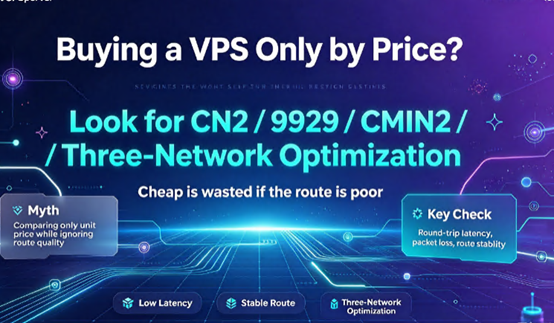
In reality, the issue often isn't that the server itself is faulty, but rather that the network route was chosen poorly. When selecting a VPS, there is one golden rule: regardless of the platform, always check the network route before looking at hardware specifications or price. If a VPS doesn't explicitly specify "CN2," "9929," "CMIN2," or "optimized for all three major carriers," it’s likely little more than a "toy." Don't be tempted to buy it just because it’s cheap—you’ll only end up wasting your money.
Why is the network route the "lifeline" of a VPS?
Data packets traveling from your local computer to an overseas data center—and back again—rely on a specific path, and the "traffic conditions" along this route directly determine your user experience. If your data travels via the standard "163" backbone network (AS4134), it’s like driving on a road that’s not only heavily congested—carrying over 90% of the country's total internet traffic—but also lacks any traffic prioritization. During evening peak hours, when everyone is trying to get through, high latency and significant packet loss become the norm.
Conversely, VPS offerings labeled with "CN2," "9929," or "CMIN2" utilize "premium express lanes" specifically optimized by the three major Chinese telecom carriers for international access. These routes offer greater bandwidth and superior conditions, and—crucially—they enjoy high Quality of Service (QoS) priority during peak evening hours. In practice, a high-quality, optimized 5 Mbps connection can easily outperform a standard, unoptimized 100 Mbps international connection.
An In-Depth Look at the Four "Gold Standard" Routes
To avoid falling into a trap, you need to familiarize yourself with these routes.
CN2 (specifically CN2 GIA): This is China Telecom’s top-tier carrier network. You will often see "CN2 GT" and "CN2 GIA" on the market—look for "CN2 GIA." Its hallmark is that both the outbound and inbound traffic travel exclusively through "59.43" nodes, bypassing the congested "202.97" nodes. It consistently maintains a packet loss rate of under 1%, making it the premier choice for China Telecom users. AS9929: China Unicom’s premium network. Because China Unicom’s international egress traffic load is relatively light, the AS9929 route offers exceptional network "purity," with minimal latency and jitter. In many cases, its stability rivals that of CN2 GIA, making it the top choice for China Unicom users, especially those in Northern China.
CMIN2: A high-end international route (AS58807) heavily promoted by China Mobile over the past two years. In the past, China Mobile users often faced "detoured" traffic when accessing international sites; CMIN2, however, provides a dedicated, high-priority channel specifically optimized for cross-border access, effectively eliminating the frustrations often associated with China Mobile’s restrictive network environment.
"Three-Network Optimization" (Optimized for China Telecom, Unicom, and Mobile): If a VPS is only optimized for China Telecom, users on China Unicom or China Mobile will still experience lag. "Three-network optimization" means the data center has carefully configured its routing: China Telecom traffic is routed via CN2 GIA, China Unicom via AS9929 or AS4837, and China Mobile via CMIN2. By ensuring each carrier’s traffic follows its own dedicated, optimized path, users enjoy a smooth experience regardless of their internet service provider.
Why should you avoid services that don’t specify their network routes?
Providers that won’t disclose their core network routes are often hiding something.
Some may pass off standard, non-optimized routes as "premium" ones. They might advertise "high-speed direct connections," but a quick route trace reveals that traffic is actually being detoured through Japan or the United States, resulting in latency exceeding 200ms.
Others may severely oversell their shared bandwidth. They might claim to offer "100Mbps high-bandwidth," but in reality, that capacity is shared among dozens of users. During evening peak hours, if a "neighbor" starts a large download, you might find yourself unable to even establish an SSH connection.
Choosing such a VPS might save you a few bucks upfront, but you will end up paying a much higher price in the form of service interruptions, lost customers, and wasted time spent troubleshooting.
How to verify and choose?
Once you’ve identified the right network route, the next step is to find a reliable service provider. Reputable providers are not only transparent about their network routes but also provide test IP addresses, allowing you to verify the performance yourself. Whether for Hong Kong or Japan locations, Jtti’s infrastructure is configured according to rigorous, high-standard routing logic. In terms of both hardware and policy, all Jtti offerings come with dedicated, non-oversold bandwidth, paired with NVMe SSDs to ensure high-performance read/write speeds. Crucially, Jtti provides a lifetime recurring discount—the price you pay at the initial purchase remains the same for all future renewals. There are no "bait-and-switch" tactics here, such as offering a low price for the first year only to double it upon renewal.
The most direct way to verify network quality is to examine the return route (the path data takes back to you). You can use the `mtr` tool locally with a test IP to trace the path. If the return route includes specific nodes like 59.43 (CN2), 9929, or CMIN2—and avoids falling into the 202.97 (standard/congested) route—then the underlying network infrastructure is solid.
When buying a VPS, you are essentially paying for network quality. Follow this priority list: first, check for premium routing (CN2, 9929, CMIN2, or "optimized for all three major carriers"); next, look at the hardware specifications; and finally, consider the price. It is far better to spend a little more for a rock-solid, optimized connection than to waste money on "digital junk" that becomes completely unreachable during evening peak hours.