
 EN
 CN
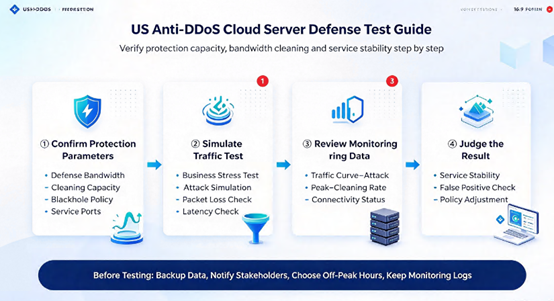
When renting a high-DDoS-protection server in the U.S.,the worst-case scenario is finding that a service advertised with"300G protection"collapses the moment an actual attack occurs.There is a systemic issue in the market where protection capacities are exaggerated—a low-cost plan might claim"500G protection"while its actual scrubbing capacity is less than 50 Gbps.Furthermore,overselling within shared clusters leads to contention for scrubbing resources,often resulting in legitimate traffic being dropped during peak attack periods.Evaluating protection capacity shouldn't rely on marketing claims;instead,one should assess the speed at which scrubbing is triggered,the breadth of protocol coverage,and the rate of false positives(legitimate traffic being blocked).This article outlines a legitimate,controllable,and reproducible testing process for U.S.-based high-protection cloud servers.
Before Testing:Authorization,Monitoring,and Baselines—Three Essential Prerequisites
First:Obtain written authorization.Most reputable high-protection service providers strictly prohibit users from conducting their own DDoS tests against their networks—unless using an official stress-testing platform or having secured prior written approval and a designated testing window.Unauthorized testing can lead to service suspension or even legal liability.When coordinating with customer support,clearly define your testing objectives(e.g.,verifying 50 Gbps SYN Flood protection),the testing timeframe(ideally during off-peak hours),and the range of source IPs to be used.Jtti,for instance,provides support for stress testing;users can confirm the authorization process and testing window via a support ticket.
Second:Establish a monitoring matrix.Testing without monitoring data is like shooting in the dark.On the server side,you should track four core metrics:network traffic(using`iftop-i eth0`),TCP connection states(using`watch-n 1'netstat-n|awk'/^tcp/{++S[$NF]}END{for(a in S)print a,S[a]}''`),system resource utilization(using`htop`),and real-time bandwidth consumption.Within the service provider’s console,focus on three key data streams:total inbound traffic,post-scrubbing traffic,and attack traffic.The definitive proof that scrubbing is functioning correctly is that while inbound traffic spikes,the post-scrubbing traffic remains stable.
Third:Establish a performance baseline.Before initiating any attack traffic,establish a baseline by recording the system's normal state:measure actual bandwidth using`iperf3`,record latency via multi-node`ping`tests,and monitor CPU and memory idle/usage rates using`htop`.Without a baseline,it is impossible to determine whether any observed increases in latency or packet loss during subsequent attack tests are caused by the attack itself or by pre-existing issues.
Core Testing:Attack Vectors and Tool Selection
The defensive capabilities of a high-protection server must be validated through cross-protocol testing;relying on a single type of attack is insufficient.Real-world attacks are typically multi-vector,spanning the network,protocol,and application layers.
TCP SYN Flood(Protocol Layer):This is one of the most frequent attack types,aimed at exhausting the server's connection table.Use`hping3`with the command:`hping3-S-p 80--flood[target IP]`.During the test,focus on two key metrics:how quickly the connection table fills up(monitored via the number of`SYN_RECV`states in`netstat`)and whether legitimate TCP handshakes can still be completed within an acceptable timeframe once traffic scrubbing is triggered.If legitimate users remain unable to connect after scrubbing,it indicates that the scrubbing policy is incorrectly dropping valid SYN packets.
UDP Flood(Network/Traffic Layer):This type of attack aims to saturate available bandwidth.Simulate it using`hping3--udp--flood-p 53[target IP]`.The value of this test lies in verifying the effectiveness of bandwidth scrubbing—specifically,whether traffic remains stable after scrubbing as the attack volume scales from zero to 50%of the nominal capacity,and whether the resulting increase in latency for legitimate services stays within a reasonable range.If,for instance,inbound traffic reaches 100 Gbps but a significant volume of anomalous UDP packets still reaches the server after scrubbing,it suggests that the scrubbing cluster lacks sufficient throughput capacity.
HTTP Flood/CC(Application Layer):While these attacks may not involve massive traffic volumes,they are potent enough to cripple web services.Tools such as`GoldenEye`or`HULK`can be used to simulate a large number of seemingly legitimate HTTP requests.During testing,observe whether the Web Application Firewall(WAF)or CC protection rules are triggered,and verify that critical user workflows—such as logging in or processing payments—remain functional after these defenses are activated.A typical failure scenario occurs when a CC(Challenge Collapsar)attack is successfully intercepted,but legitimate user JSON API requests are also blocked by the same"malformed packet"filtering rules.
Hybrid attacks(which most closely resemble real-world scenarios):Actual attacks rarely rely on a single vector.When approaching the stated defense capacity,introduce a mix of SYN Flood and HTTP Flood traffic for 15 minutes.Observe whether the defense system experiences rule conflicts or the exhaustion of scrubbing resources under this dual-layer(protocol and application)pressure.
Three Key Metrics for Evaluating High-Defense Services
Once testing is complete,the data will reveal the true defense capacity of the system.
Authenticity of Scrubbing Capacity:Focus on the"delta"(the difference),not the advertised figures.If a provider claims a"500G defense capacity"but their scrubbing cluster collapses under 200 Gbps of traffic,that is definitive proof of inflated claims.To verify:compare the incoming attack traffic(at the ISP level)with the traffic that actually reaches the server;the difference represents the volume of traffic successfully scrubbed.If this difference is less than 80%of the advertised capacity,the stated figures are likely exaggerated.
Scrubbing Trigger Speed:This should be≤30 seconds.The trigger time is the duration from the onset of an attack until the"post-scrubbing traffic"curve in the provider’s console stabilizes.A competent scrubbing system should complete traffic redirection and load the necessary filtering rules within 30 seconds of an attack(such as a UDP or SYN Flood)hitting a specific threshold.If the trigger time exceeds one minute,services relying on long-lived connections—such as APIs or online games—will likely have already collapsed.
False-Positive Rate:Legitimate users should not be collateral damage.The greatest risk with high-defense services is not that they"fail to block"an attack,but that they are"too aggressive."During testing,initiate legitimate business requests(e.g.,HTTP GET requests or API calls)from a clean IP address and track the proportion of these requests that are incorrectly blocked during the attack.A high-quality defense service should maintain a false-positive rate below 0.01%,with any increase in service latency kept within an acceptable range.If the defense measures cause legitimate users to frequently encounter CAPTCHAs,connection resets,or payment failures,then a high"defense capacity"figure becomes practically meaningless.The defense capacity of a high-protection cloud server in the U.S.is not determined by the figures a provider claims,but by its actual performance in terms of traffic-scrubbing trigger speed,protocol coverage,and the rate of false positives.A truly reliable service requires thorough preparation—covering authorization,monitoring,and baseline establishment—along with validation through multi-vector attack simulations to test scrubbing capabilities,and the use of"clean"IP addresses to ensure legitimate traffic is not inadvertently blocked.Only when defense metrics are backed by empirical data is a service worth paying for.Visit the official Jtti website to explore comprehensive protection solutions and test IP addresses for our U.S.-based high-protection servers.